
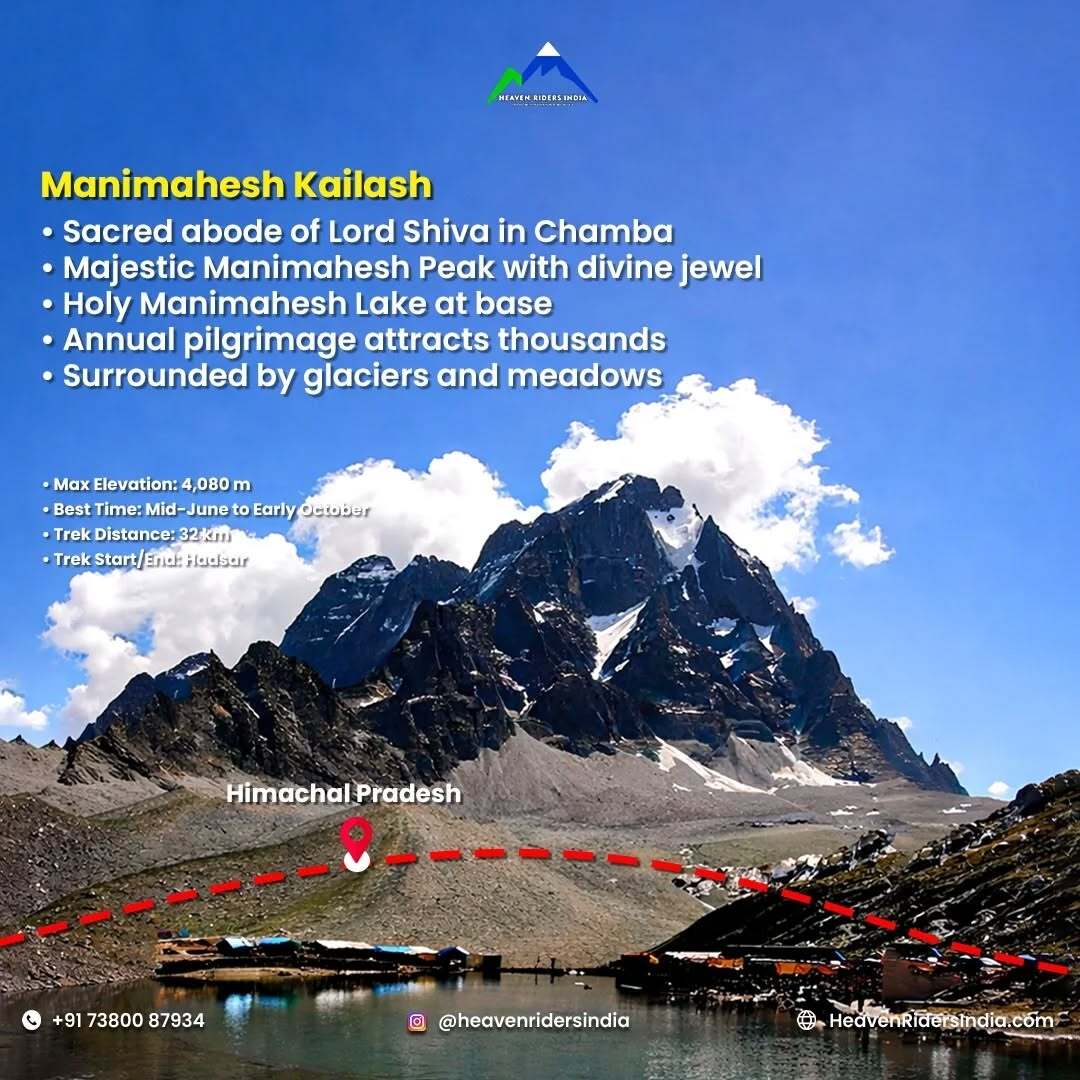
Manimahesh Yatra is not just a trek, but it is a spiritual experience, a divine trek through the beautiful mountain ranges in Himachal Pradesh, India. The holy Manimahesh Lake is situated at an altitude of 4,080 meters above sea level, in close proximity to the majestic Mount Kailash, popularly known as Chamba Kailash.
For the Hindus, this trek is a spiritual experience and is considered one of the Panch Kailash Yatras, second only to Lake Manasarovar in spiritual significance.
Spiritual Significance of Manimahesh
According to Hindu mythology, the lake was formed by Lord Shiva after marrying Goddess Parvati. It is said that Lord Shiva meditated at the site of the lake for 700 years. It is believed that the water of the lake flows from the hair of Lord Shiva.
There is a rock formation at the site of the lake, resembling the Shivling. It is believed that the rock formation is Lord Shiva himself. The snowfield at the base of the mountain is called ‘Shiva’s Chaugan.’
It is believed that taking a holy dip at the site of the lake during the Manimahesh yatra cleanses the sins of the pilgrims.
Why Manimahesh Yatra is Special
Unlike other yatra, Manimahesh Yatra offers a combination of spirituality and adventure. The yatra takes the pilgrims through the forest, rivers, waterfalls, and mountainous regions covered with snow.
The state government has officially announced Manimahesh Yatra as a state-level yatra. Every year, during the period of Janmashtami to Radha Ashtami (August-September), thousands of pilgrims start their sacred journey.
At the periphery of the lake, the marble statue of Lord Shiva, also called the ‘Chaumukha,’ is worshipped. There is a small temple resembling the ‘shikhara’ style, with a brass idol of Mahishasuramardini, or Lakshmi Devi.
Route Guide – Bharmaur to Hadsar to Manimahesh Lake
The most popular route is from Chamba district.
Step 1: Reach Bharmaur
Bharmaur is the starting point for the Manimahesh Lake pilgrimage. It is connected to Chamba by road.
Step 2: Bharmaur to Hadsar
From Bharmaur, we proceed on a road journey to Hadsar, which is the last point for a motorable road.
Step 3: Trek from Hadsar (15 km)
During the 15-kilometer trek, we visit several points:
- Dhancho – It is a beautiful location for a halt, along with waterfalls.
- Sundrasi – It is a beautiful location for a halt.
- Gaurikund – It is a sacred pond dedicated to Goddess Parvati.
From Gaurikund, we proceed to the sacred lake.
There are other routes to Manimahesh Lake, namely from Kugti Pass via Lahaul and Spiti, and from Kawarsi or Jalsu Pass via Kangra and Mandi. However, the most popular route is from Bharmaur to Hadsar.
Trek Difficulty Level
The difficulty level of the Manimahesh Yatra trek is moderate. Beginners with a fair level of fitness can undertake this trek. However, it is necessary to be prepared for the trek.
Recommended Preparation:
- Practice walking for 3 to 4 weeks
- Carry warm clothes even if it is summer
- Hydrate yourselves
- Start early
- Avoid plastic waste
Best Time to Visit
The pilgrimage begins after Janmashtami and lasts till Radha Ashtami (usually in August and September).
- Weather during this time:
- Day temperature: 10°C to 20°C
- Night temperature: Can fall below 5°C
- Rest of the year, the place is not accessible because of the snow.
- Cultural Importance of Bharmaur
Bharmaur is also known for the ancient 84 temple complex dedicated to Lord Shiva. The pilgrims visit these temples before the Manimahesh Yatra.
The area is known for the traditional Himachali culture and the hospitality of the people.
Sustainable & Responsible Travel
As a modern traveler, it is essential to focus on the following:
- Do not litter
- Respect the local culture
- Do not play loud music
- Support the local vendors
The Himalayan range is a fragile ecosystem. Responsible tourism is essential so that the coming generations may also experience the divine beauty of the Manimahesh Yatra.
Who Should Do Manimahesh Yatra?
The Manimahesh Yatra is suitable for:
- Spiritualists
- Adventure enthusiasts
- Photography enthusiasts
- Lord Shiva worshippers
- Cultural enthusiasts
If you are looking for a pilgrimage that is a blend of spirituality and Himalayan grandeur, then Manimahesh Yatra is the right choice.
Travel Tips for 2026 Pilgrims
- Pre-register if required by the government.
- Check the weather forecast before you leave.
- Bring your ID proof.
- Keep small amounts of cash handy.
Book your accommodation at Bharmaur well in advance during peak season.
FAQs – Manimahesh Yatra
- At what altitude is Manimahesh Lake situated?
Manimahesh Lake is located at an altitude of 4080 m.
- What is the duration of the trek?
The trek one way is 15 Kms from Hadsar to Manimahesh Lake.
- When is the Manimahesh Yatra celebrated?
Manimahesh Yatra happens from Janmashtami to Radha Ashtami.
- Is the trek difficult?
It is a moderate trek. Anyone can undertake it if they are reasonably fit.
- Is it safe for beginners?
Yes, it is safe for beginners if they undertake it during the pilgrimage season.
Final Thoughts
Manimahesh Yatra is not just a pilgrimage. It is a spiritual awakening, located in the lap of the Himalayas. From Bharmaur to Hadsar, and finally to the sacred lake, every step is a step into devotion, peace, and natural splendor.
In 2026 and beyond, with search engines built on the value of real experiences and real information, travelers will increasingly crave spiritual experiences. Manimahesh will provide exactly that.





Comment (0)