





- heavenridersindia@gmail.com
(INR) ₹

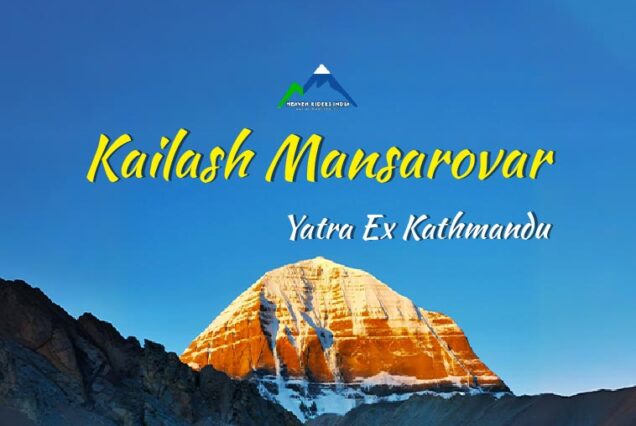
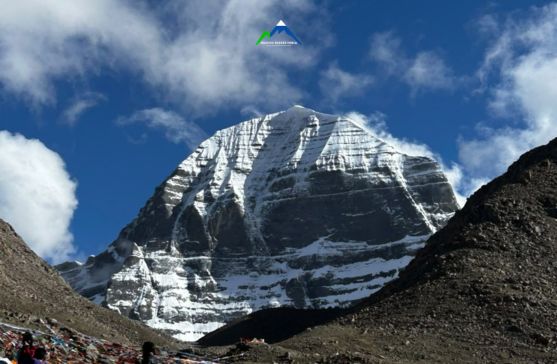
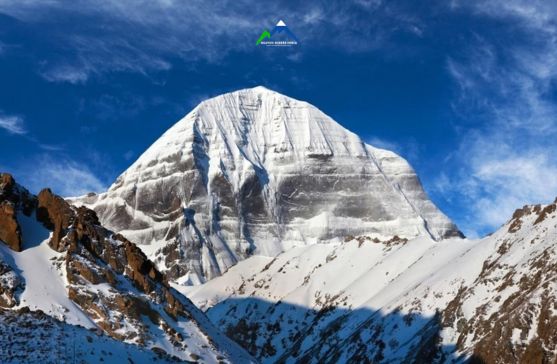
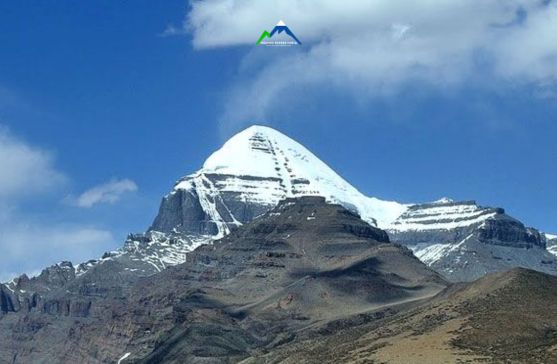
The Kailash Mansarovar Yatra is a dream journey for many pilgrims. Located in the remote Tibetan region, Mount Kailash (6,638 metres) and the beautiful Lake Mansarovar (over 4,500 metres above sea level) hold deep spiritual importance for millions of people.
For Hindus, Mount Kailash is believed to be the home of Lord Shiva and Goddess Parvati. It is equally sacred to followers of Buddhism, Jainism, and the Bon religion. Every year, pilgrims travel from India and other parts of the world to seek blessings, perform religious rituals, and experience the peaceful surroundings of this holy mountain.
Depending on the route, the Kailash Mansarovar Yatra usually takes between 12 and 24 days. The journey involves long road journeys, flights, high-altitude travel, and, for those choosing to complete it, the challenging 52-km Kailash Parikrama.
Many pilgrims believe that completing one Parikrama helps wash away the sins of a lifetime and brings them closer to spiritual liberation.
Since the region is remote and access is restricted to a limited travel season, proper planning is important. Permits, visas, accommodation, transportation, and medical preparations should be arranged well in advance through an authorised tour operator.
Mount Kailash is one of the few mountains in the world that holds such deep religious importance across different faiths. Interestingly, despite its popularity among pilgrims and mountaineers, nobody has climbed its summit. The mountain remains untouched out of respect for its religious significance.
Here’s why Mount Kailash is considered sacred by four major religions.
Hinduism
In Hindu tradition, Mount Kailash is believed to be the eternal home of Lord Shiva and Goddess Parvati. It is also associated with Mount Meru, which is considered the centre of the universe. For devotees of Lord Shiva, visiting Kailash is a deeply personal spiritual experience.
Buddhism
Tibetan Buddhists regard Mount Kailash as the home of Demchok (Chakrasamvara), a deity associated with supreme bliss. The mountain is also considered an important spiritual centre in Buddhist cosmology.
Jainism
In Jain tradition, Mount Kailash is associated with Ashtapad, where Rishabhanatha, the first Jain Tirthankara, is believed to have attained moksha (liberation).
Bon Religion
The Bon religion, an ancient spiritual tradition of Tibet, considers Mount Kailash a sacred place and the home of the sky goddess Sipaimen. It is regarded as an important centre of spiritual power.
Lake Mansarovar also has a special place in Hindu beliefs. According to tradition, Lord Brahma created the lake through his mind. Pilgrims believe that taking a holy dip in its water helps cleanse the soul and wash away accumulated karma.
The Kailash Parikrama, also known as the Kailash Kora, is considered the most important part of the pilgrimage for many devotees.
During the Parikrama, pilgrims walk around Mount Kailash along a circular route of approximately 52 km. The journey usually takes three days and passes through remote valleys, rocky paths, glaciers, and high-altitude mountain terrain.
One of the most challenging sections is the climb to Dolma La Pass, which stands at approximately 5,630 metres. The steep ascent, thin air, and changing weather make this stretch physically demanding.
Despite the difficulty, many pilgrims consider crossing Dolma La Pass a deeply meaningful moment of their journey.
According to religious beliefs, completing one Parikrama helps a person overcome the sins of their lifetime, while completing 108 Parikramas is traditionally associated with attaining moksha.
Pilgrims who find the trek difficult because of age or physical limitations may be able to arrange pony or yak support on permitted sections. Those who cannot undertake the full Parikrama can also explore darshan-only packages, depending on the available arrangements.
There are two main forms of Parikrama associated with Mount Kailash: the Outer Kora and the Inner Kora.
Although both routes have religious importance, they differ in distance, difficulty, accessibility, and the experience they offer.
The Outer Kora is the traditional route followed by most pilgrims.
The Inner Kora follows a more challenging route closer to Mount Kailash, including areas around Nandi Parvat.
Traditionally, many pilgrims complete the Outer Kora before attempting the Inner Kora. However, Inner Kora access has historically depended on Chinese authorities and local restrictions. It may not be available every year.
| Feature | Outer Kora | Inner Kora |
|---|---|---|
| Distance | Approximately 52–54 km | Approximately 30–35 km |
| Duration | 2–3 days | 1–2 days |
| Highest point | Dolma La Pass, around 5,630 m | Saptarishi Cave area, around 5,860 m |
| Difficulty | Strenuous | Extremely challenging |
| Facilities | Monasteries and guesthouses along the route | Very limited facilities |
| Permissions | Standard Yatra permits | Additional permissions may be required |
| Who attempts it | Most Parikrama pilgrims | Experienced and well-prepared pilgrims |
The Kailash Mansarovar Yatra takes pilgrims through several sacred places. Each location has its own religious story and significance. Here are some of the important places you may come across during the journey.
Mount Kailash is the main attraction of the entire pilgrimage. Its distinctive pyramid-like shape and snow-covered slopes make it instantly recognisable.
For Hindus, it is believed to be the home of Lord Shiva. For followers of other religions, it also holds deep spiritual meaning. Seeing the mountain for the first time is an emotional moment for many pilgrims.
Located near Mount Kailash, Lake Mansarovar is one of the holiest lakes in the world.
Its clear blue water and mountain surroundings create a peaceful atmosphere. Pilgrims often perform prayers and religious rituals along its banks. Many also take a holy dip, following their religious beliefs.
Gauri Kund is a small sacred lake located along the Kailash Parikrama route, near the ascent towards Dolma La Pass.
According to Hindu belief, this is associated with Goddess Parvati. Its location and spiritual importance make it a special stop for pilgrims.
Rakshas Tal, also called Rakshastal, is a saltwater lake located close to Lake Mansarovar.
According to Hindu mythology, the lake is associated with Ravana’s penance to please Lord Shiva. Its surroundings look quite different from the peaceful landscape of Mansarovar, making the two lakes an interesting contrast.
Hanuman Tal is a lesser-known water body associated with Lord Hanuman. Depending on the itinerary, pilgrims may visit this location for prayers and a moment of reflection.
Yam Dwar is traditionally considered the starting point of the Kailash Parikrama.
Its name is often interpreted as the Gateway of Death and Rebirth. For pilgrims, passing through Yam Dwar represents leaving behind worldly attachments and beginning a spiritual journey around Mount Kailash.
Dolma La Pass is the highest point of the Outer Kora, standing at approximately 5,630 metres.
The climb is difficult because of the steep terrain, high altitude, and low oxygen levels. However, crossing this pass is considered one of the most meaningful moments of the entire pilgrimage.
The pass is named after Goddess Tara, also known as Dolma, in Tibetan Buddhism.
Ashtapad is an important sacred location in Jain tradition. It is believed to be the place where Rishabhanatha, the first Tirthankara, attained liberation.
For Jain pilgrims, the site holds special religious importance.
Nandi Parvat is a mountain peak near Mount Kailash. In Hindu tradition, it is associated with Nandi, the sacred bull and vehicle of Lord Shiva.
The peak is particularly important for pilgrims interested in the spiritual geography surrounding Kailash.
The Saptarishi Caves are associated with the seven great sages of Hindu tradition. According to religious beliefs, these sages meditated in this region.
The caves are also connected with the spiritual significance of the Inner Kora.
Located in Kathmandu, Nepal, Pashupatinath Temple is one of the most important temples dedicated to Lord Shiva.
Many Kailash Mansarovar itineraries include a visit to this temple before travelling towards Tibet. Pilgrims often begin their journey with prayers and blessings here.
Jal Narayan, also known as Budhanilkantha Temple, is a sacred Hindu temple in Kathmandu.
It is famous for its large stone statue of Lord Vishnu resting on a bed of serpents in a water tank. Some Nepal-route itineraries include a visit to this temple.
Boudhanath Stupa is one of the largest and most important Buddhist stupas in Nepal.
Located in Kathmandu, it is a peaceful place where visitors can observe Buddhist prayer traditions, prayer wheels, and the daily activities of devotees.
Guhyeshwari Mata Temple is an important Shakti Peeth in Kathmandu, dedicated to Goddess Guhyeshwari.
It is located near Pashupatinath Temple and is commonly included in Nepal-route pilgrimage itineraries.
Choosing the right time for the Kailash Mansarovar Yatra is important because the region experiences long, extremely cold winters and has a relatively short travel season.
The pilgrimage generally takes place between May and early October. During the winter months, heavy snowfall, freezing temperatures, and blocked mountain passes make travel difficult or impossible.
Here’s what you can expect during different months.
May marks the beginning of the Kailash Mansarovar travel season.
Daytime temperatures generally range between 8°C and 17°C, while nights can drop to around -3°C to -8°C. Snow may still be present on higher sections of the route, particularly around Dolma La Pass.
May is also associated with the Saga Dawa Festival, one of the most important occasions in Tibetan Buddhism. The festival commemorates the birth, enlightenment, and parinirvana of Gautama Buddha.
In 2026, Saga Dawa falls on May 31.
During this period, many Tibetan pilgrims visit Mount Kailash to perform the Kora. The ceremony at Tarboche, where a large prayer-flag pole is raised, is another important part of the celebrations.
If you plan to travel during this time, book early because accommodation and local support services can become busy.
June is often considered one of the better months for the Kailash Mansarovar Yatra.
Most of the winter snow has melted from the lower sections of the route, making walking conditions more manageable. Daytime temperatures generally stay between 11°C and 17°C, although nights remain cold.
The month also marks the beginning of the official Indian government-organised Yatra batches through Lipulekh and Nathu La.
Weather conditions can change towards the end of June, so carrying proper rain and cold-weather protection is still important.
July is one of the busiest months for the pilgrimage.
The daytime weather is relatively comfortable compared with the colder months, and many people prefer travelling during their summer holidays.
However, July also falls within the monsoon season across much of the Himalayan region.
Mount Kailash lies in a rain-shadow area, so it generally receives less rainfall than places such as Kathmandu and the lower Himalayan foothills. Still, occasional showers, cloud cover, and muddy patches can affect travel conditions.
August continues the main pilgrimage season.
The days are generally comfortable, while occasional rainfall may occur along the approach routes. The surrounding valleys can look greener during this period.
Since August is a popular month for both government and private Yatra batches, pilgrims should book their travel arrangements early.
September is a good option for pilgrims who prefer clearer mountain views and relatively fewer crowds.
The monsoon generally begins to withdraw, improving visibility across the Tibetan plateau. The cooler weather also makes the mountain landscape look especially beautiful.
Many travellers consider September one of the best months for photography and enjoying views of Mount Kailash and Lake Mansarovar.
Early October can still offer clear skies and good views of the surrounding mountains.
However, temperatures begin to fall, and the chances of early snowfall increase as the month progresses. Some guesthouses and local services also start preparing for winter closures.
Travelling during this period requires flexible dates and an operator who closely monitors local weather and road conditions.
There are different ways to reach Mount Kailash and Lake Mansarovar. Your choice depends on your budget, available time, fitness level, and preferred travel experience.
As of 2026, pilgrims generally consider four main travel options.
The Lipulekh Pass route is one of the oldest routes used by Indian pilgrims to reach Kailash Mansarovar. It has been used for the pilgrimage since 1954.
The route passes through Uttarakhand before entering Tibet through Lipulekh Pass, which is located at approximately 5,334 metres.
This Yatra is organised by the Ministry of External Affairs (MEA), Government of India, in coordination with the Chinese authorities.
Unlike the motorable Nathu La route, the Lipulekh route involves trekking through the Himalayan region on the Indian side before crossing into Tibet.
It is physically demanding, so participants should prepare themselves for long walks and high-altitude conditions.
For 2026, the government scheduled 20 batches of 50 pilgrims each between June and August, divided between the Lipulekh and Nathu La routes.
Applications are submitted through the official government portal:
Selection is conducted through a computerised draw of lots. Selected applicants must also complete the required medical examinations in Delhi before departure.
The Nathu La Pass route is another option organised by the Indian government.
Located on the Sikkim-Tibet border at approximately 4,310 metres, this route is largely motorable on both sides of the border. This means pilgrims do not have to undertake the long Himalayan trek required on the Lipulekh route.
The journey generally begins in Gangtok and takes around 20–25 days, including travel through India and Tibet.
Since much of the journey involves road travel across the Tibetan plateau, the cost can be higher than the Lipulekh option.
This route may suit pilgrims who want to reduce the amount of trekking before reaching Mount Kailash. It can also be worth considering for older travellers, subject to medical fitness and official eligibility requirements.
However, remember that reaching Kailash by road does not remove the physical challenge of the Parikrama. Pilgrims who choose to complete the Outer Kora still need to walk through high-altitude terrain.
Many pilgrims choose to travel through Nepal because private operators can offer different departure dates and travel arrangements.
These routes are worth considering if you do not want to depend on the Indian government’s selection process or need a package that fits your schedule.
Some common options include:
Kathmandu to Kerung (Overland Route)
The journey begins with a flight to Kathmandu, followed by road travel towards the Kerung/Rasuwagadhi border.
After entering Tibet, pilgrims continue towards Saga, Paryang, and Darchen, which is the starting point of the Kailash Parikrama.
This route combines road travel with gradual movement across the Tibetan plateau.
Nepalgunj–Simikot–Hilsa Route
This route involves flights from Kathmandu to Nepalgunj and then to Simikot in the Humla district.
From Simikot, pilgrims travel towards Hilsa by helicopter or trekking arrangements before entering Tibet through the Nepal-China border.
It is a useful option for travellers looking for a shorter approach to the Tibetan border, although flight and weather conditions can affect the schedule.
Helicopter Darshan
Helicopter packages are generally among the quickest ways to organise the Kailash Mansarovar Yatra.
Depending on the itinerary and weather, the overall journey can sometimes be completed in around 9–11 days.
This option may suit older pilgrims or people with limited travel time. However, it is considerably more expensive than many road-based packages.
Also, helicopter transfers do not automatically include the full Kailash Parikrama. Check the itinerary carefully before booking.
The Lhasa route is another option, particularly for travellers who want to explore more of Tibet along with their Kailash Mansarovar pilgrimage.
The journey usually begins with a flight to Lhasa, followed by an overland drive through places such as Shigatse and Saga before reaching Darchen.
This route allows travellers to visit other well-known Tibetan attractions, including the Potala Palace and Everest Base Camp, depending on the itinerary.
However, the journey takes more time and requires proper acclimatisation because travellers spend several days at high altitude.
The Lipulekh route has also been the subject of a territorial disagreement between India and Nepal.
In 2026, Nepal raised objections to the Kailash Mansarovar Yatra taking place through Lipulekh, citing its claims over the Lipulekh, Limpiyadhura, and Kalapani areas.
India rejected Nepal’s position and maintained that Lipulekh is an established pilgrimage route that has been used since 1954.
The 2026 pilgrimage season was scheduled to proceed through both Lipulekh and Nathu La.
Since border arrangements and government policies can change, pilgrims should always confirm the latest information with the Ministry of External Affairs or their tour operator before making travel plans.
The Kailash Mansarovar Yatra is physically demanding, especially for people planning to complete the full Parikrama.
Even if you exercise regularly, travelling at an altitude above 4,500 metres can feel very different from normal trekking. The body needs time to adjust to lower oxygen levels.
Here are some challenges you should understand before planning your journey.
Most of the journey takes place above 4,500 metres. The highest point of the Outer Kora, Dolma La Pass, is approximately 5,630 metres above sea level.
At this height, oxygen availability is much lower than at sea level. You may experience headaches, tiredness, dizziness, nausea, or difficulty sleeping.
These can be signs of Acute Mountain Sickness (AMS). It can affect anyone, regardless of age or previous trekking experience.
Proper acclimatisation and early attention to symptoms are important.
Weather in the Kailash region can change quickly.
You may experience pleasant sunshine during the day, followed by strong winds, snowfall, hail, or freezing temperatures within a short time.
The weather can be particularly challenging around Dolma La Pass. Carrying suitable warm clothing and waterproof layers is essential.
Medical facilities are limited in some sections of the Kailash Parikrama.
The stretch between Dirapuk and Zutulpuk has no regular vehicle access, making emergency evacuation difficult.
Government-organised routes may provide basic medical support and liaison officers, but serious medical emergencies can require additional evacuation arrangements.
The second day of the Outer Kora is usually the toughest part of the trek.
Pilgrims may need to cover around 22–24 km while climbing towards Dolma La Pass and descending towards the next camp.
The challenge comes from the combination of distance, steep sections, and low oxygen levels.
Even people who are comfortable walking long distances at lower altitudes may find this day difficult.
Medical screening is an important part of the Yatra.
Government-organised batches require participants to meet the prescribed medical fitness standards. Private operators also generally ask travellers to submit medical fitness documents before departure.
People with serious heart conditions, respiratory problems, or uncontrolled blood pressure should seek medical advice before considering the journey.
The Yatra can still be completed by many older pilgrims, depending on their health and the route they choose. Road-based options and permitted pony or yak support may help reduce certain physical demands.
However, no route should be considered completely free from high-altitude risks.
How should you prepare?
Start preparing at least two to three months before departure.
Most importantly, never ignore signs of altitude sickness or push yourself to continue when you feel unwell.
Since the pilgrimage involves high-altitude travel and physically demanding activities, participants must meet certain eligibility and medical requirements.
The exact conditions can vary depending on the route, government rules, and tour operator.
Age: Private operators generally accept pilgrims within specified age limits, often between 18 and 70 years. Additional medical clearance may be required for older participants.
Medical Fitness: Travellers should not have serious heart conditions, chronic respiratory diseases, uncontrolled high blood pressure, or other medical conditions that could become dangerous at high altitude.
Physical Fitness: You should be comfortable walking for several hours and managing long travel days. Previous trekking experience is helpful, particularly if you plan to complete the Outer Kora.
Nationality Requirements: Indian citizens travelling through Nepal generally need a valid passport and the required Chinese group visa. Pilgrims applying through the Lipulekh government route must complete the official MEA application and selection process.
Medical Certificate: A medical fitness certificate from a qualified doctor is required as per the applicable route and operator guidelines.
Before confirming your booking, check the latest eligibility requirements for your selected route.
The Kailash Mansarovar Yatra involves international travel and entry into the Tibetan Autonomous Region of China. Because of this, documentation and permit requirements are quite strict.
Preparing your documents early can help avoid last-minute problems.
Here are some commonly required documents for Indian pilgrims travelling through Nepal-based private packages.
1) Photos or images of Dalai Lama (in phone, print, or books)
2) Any anti-China content, including: Articles, videos, posters, or social media posts, text chat on whats app or social media, Screenshots or saved content critical of China
3) Books or maps showing disputed regions, such as: Arunachal Pradesh, Aksai Chin shown as part of India Google Maps printouts with disputed borders
4) Bulk religious material like: Multiple copies of Gita, Bible, Quran, etc. (especially for distribution)
5) Drones or surveillance-type cameras (high zoom or advanced equipment)
6) Satellite phones or communication gadgets not approved by authorities
7) Printouts or screenshots from banned websites in China: Facebook, Twitter, YouTube, Instagram, WhatsApp, etc.
8) Large prayer flags or religious/political banners, especially: Related to Tibet, Dalai Lama, or protest messages
One of the interesting things about Mount Kailash is how its appearance changes depending on where you view it from during the Parikrama.
Pilgrims often describe the mountain as having four distinct faces, each offering a different view and spiritual experience.
South Face
The South Face is among the most recognisable views of Mount Kailash. It has a striking vertical rock formation that some people associate with the sacred swastika symbol found in Hindu, Buddhist, and Jain traditions.
East Face
The East Face can be seen from certain sections around the Dolma La Pass side. It offers a different perspective of the mountain and is often associated with quiet reflection.
West Face
The West Face is visible from the Darchen side and offers the familiar pyramid-like shape seen in many photographs of Mount Kailash.
North Face
The North Face is less accessible and is viewed from specific locations along the Inner Kora. It is known for its dramatic rock formations and snow-covered appearance.
For many pilgrims, seeing the different faces of Mount Kailash during the Parikrama becomes one of the most memorable parts of the journey.
A journey to Mount Kailash and Lake Mansarovar requires careful planning. From arranging permits and visas to managing transportation, accommodation, acclimatisation, and Parikrama logistics, every part of the trip needs attention.
Having an experienced travel partner can make the planning process easier and help you understand what to expect at each stage of the journey.
At Heaven Riders India, we help pilgrims plan their Kailash Mansarovar Yatra with suitable travel arrangements and assistance throughout the booking process.
Whether you are travelling with family, planning a pilgrimage with friends, or looking for a customized package, our team can help you understand the available routes, costs, documentation, and travel requirements.
Ready to plan your Kailash Mansarovar Yatra?
Contact Heaven Riders India to discuss your travel dates, explore available packages, and get assistance with the booking process.
Contact us at :- +91 73800 87934
Start planning your journey to the sacred home of Lord Shiva and experience the beauty of Mount Kailash and Lake Mansarovar.
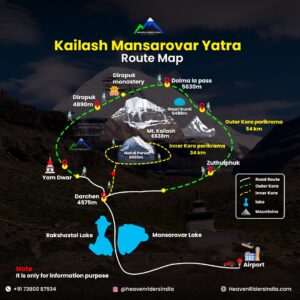
The Kailash Mansarovar Yatra route takes pilgrims through the beautiful Himalayan landscapes of Nepal and Tibet, leading to the sacred Mount Kailash and Lake Mansarovar. The journey includes major locations such as Kathmandu, Nepalgunj, Simikot, Hilsa, Taklakot, Darchen and Lake Mansarovar.
After reaching Darchen, pilgrims proceed towards Mount Kailash for the sacred 3-day Parikrama (circumambulation). The Parikrama route covers important locations including Yam Dwar, Dirapuk, Dolma La Pass, Gauri Kund and Zuthulpuk before returning to Darchen.
The route map also highlights important places along the journey, including Rakshas Tal, Ashtapad, Chiu Gompa and Mansarovar Lake. The journey may involve road travel, domestic flights, trekking and high-altitude travel depending on the selected route and package.
Note: This route map is for informational purposes only. The actual travel route, transportation and itinerary may vary depending on government permissions, weather conditions, road accessibility and local regulations.
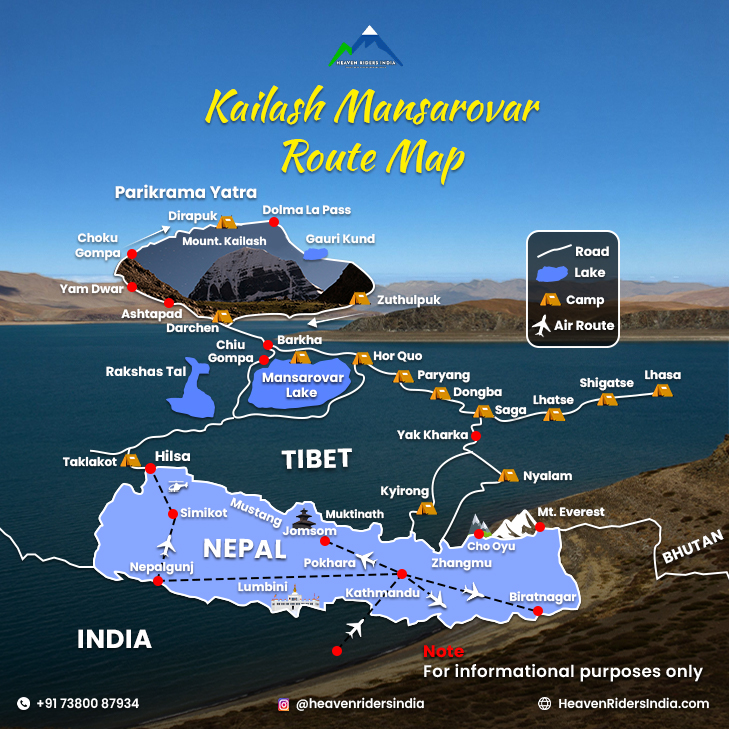
Click image to enlarge
image Gallery

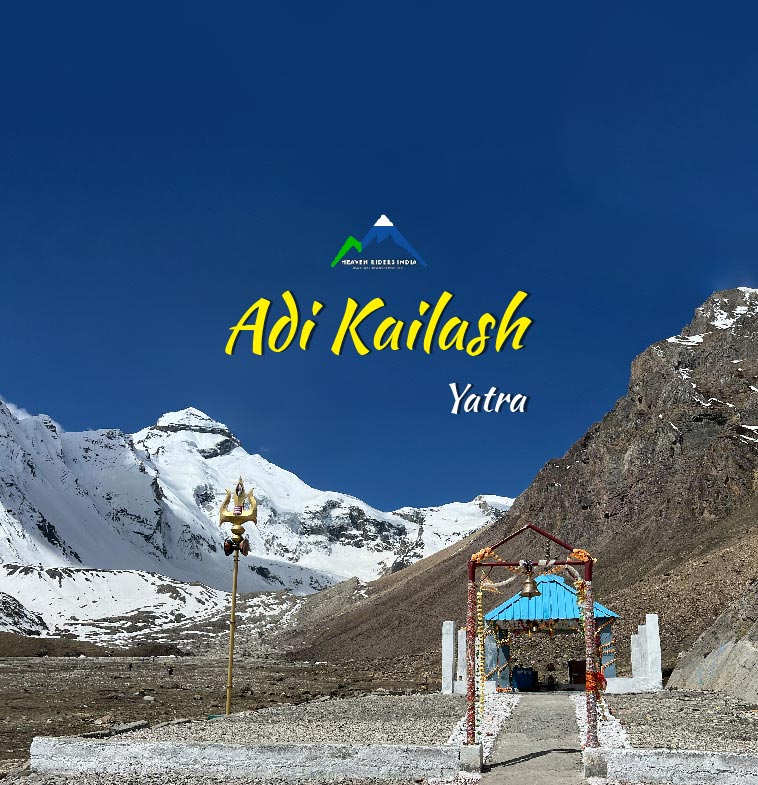
The Himalayas have a special place in the hearts of people who seek peace, spirituality and adventure. Among the many sacred destinations hidden in these mountains, Adi Kailash holds a…