Overview
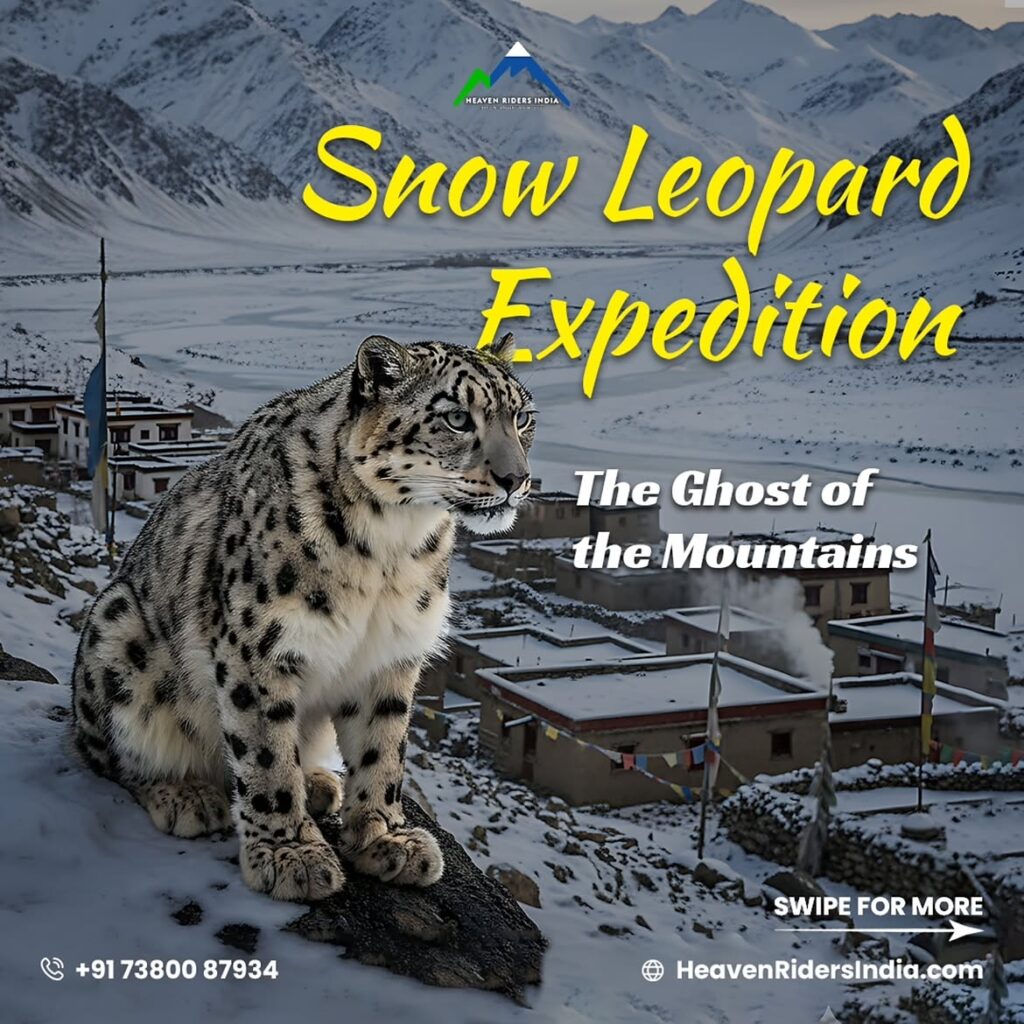
There are very few wildlife experiences on Earth that can match the thrill of standing on a frozen ridge in Spiti Valley, breath fogging in sub-zero air, scanning a rocky gorge through a spotting scope for a flicker of movement that could be the “Ghost of the Mountains.” A Snow Leopard Expedition is not a casual holiday. It is a pilgrimage into one of the most remote, high-altitude cold deserts in India, undertaken in pursuit of a creature so elusive that even seasoned wildlife photographers can spend a lifetime without a single sighting.
At Heaven Riders India, we specialize in designing expedition-grade journeys into the heart of Spiti Valley’s snow leopard territory, in the trans-Himalayan region of Himachal Pradesh. This guide walks you through everything you need to know before booking a Snow Leopard Expedition — where to go, when to go, what to expect, and why Spiti has become one of the most reliable places on Earth to see this endangered big cat in the wild.
Why a Snow Leopard Expedition in Spiti Should Be on Every Wildlife Traveler’s List
The snow leopard (Panthera uncia) is one of the rarest and most difficult big cats to observe anywhere in the world. Unlike tigers or lions, which live in relatively accessible lowland habitats, snow leopards inhabit the highest, most rugged mountain terrain on the planet — often above 4,000 meters. Their thick, pale-grey coat with rosette markings makes them almost invisible against the rocky, snow-dusted slopes of Spiti, which is exactly why they’ve earned nicknames like “the ghost cat” and “the grey ghost of the mountains.”
A well-planned Snow Leopard Expedition to Spiti offers travelers:
- The rare chance to observe a genuinely wild, endangered apex predator in its natural habitat
- Access to dramatic high-altitude cold-desert landscapes unlike anywhere else in India
- Immersion in centuries-old Spitian culture, Buddhist monasteries, and homestay traditions
- A conservation-positive travel experience that directly supports local villages
- An adrenaline-charged, once-in-a-lifetime adventure that few travelers ever attempt
What makes Spiti Valley particularly special is a conservation story unique to the region. In the 1990s, ecologist Charudutt Mishra worked with the villagers of Kibber to set aside grazing land exclusively for wild herbivores. Blue sheep populations recovered, snow leopards followed their prey down from the high cliffs, and what was once a rare, feared phantom became a regular, trackable resident of the valley. Forest officials have since camera-identified dozens of individual snow leopards within the Kibber Wildlife Sanctuary alone — making Spiti one of the most consistent snow leopard destinations anywhere in Central Asia.
Where to Go: Kibber Wildlife Sanctuary, the Snow Leopard Heartland of Spiti
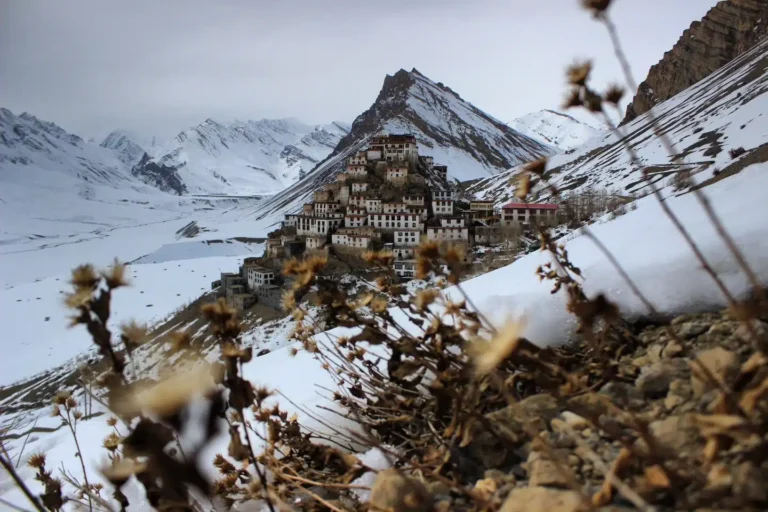
Any serious Snow Leopard Expedition in Himachal Pradesh begins and ends in and around Kibber Wildlife Sanctuary, a roughly 2,220 sq. km protected area that sits at the edge of the village of Kibber — one of the highest motorable villages in the world at around 4,270 meters.
Why Kibber Wildlife Sanctuary Is Spiti’s Snow Leopard Epicenter
Kibber’s terrain of deep gorges, open plateaux, and cliff-lined slopes makes it exceptionally well suited to spotting snow leopards from a safe distance with scopes. The sanctuary supports a strong resident population of Himalayan blue sheep (bharal) and Asiatic ibex, the primary prey species that keep snow leopards active and visible in this landscape year-round.
Key locations within and around the sanctuary that our Heaven Riders India expeditions regularly cover include:
- Kibber–Chicham plateau — the most productive and frequently visited spotting zone
- Rong Nala — a prime early-morning tracking location inside the sanctuary
- Chicham Gorge — deep ravines that act as a natural corridor and denning area for snow leopards
- Kee, Gete, and Tashigang slopes — quieter zones with excellent sighting records
- Langza, Hikkim, and Komic — high-altitude villages offering additional spotting terrain and stunning landscapes
The village of Chicham, connected to Kibber by Asia’s highest suspension bridge, has become a key base for expeditions thanks to its proximity to the gorge where sightings are most frequent.
The Best Time for a Snow Leopard Expedition in Spiti
Timing is everything on a Snow Leopard Expedition, and this is where local expertise makes all the difference.
Peak Season: Late December to Early March
Winter is, without question, the best time to spot a snow leopard in Spiti. As temperatures plunge and snow blankets the higher ridgelines, snow leopards move down into the gorges and plateaux around Kibber and Chicham in search of prey, bringing them within range of trackers and spotting scopes. Blue sheep herds also concentrate at lower elevations during this period, drawing the cats down with them.
Expect:
- Daytime temperatures often between -5°C and -15°C
- Night temperatures that can plunge close to -25°C to -30°C in exposed areas
- Clear, dry skies with excellent visibility for spotting
- The strongest and most consistent sighting probability of the year
Shoulder Season: Late November and Late March
These weeks offer a good compromise — slightly milder temperatures with still-strong sighting probabilities, ideal for travelers who want the winter experience without the harshest cold.
Summer Months: Not Recommended for Sightings
Between April and October, most of Spiti’s high mountain roads are more accessible, but snow leopards retreat to higher, less accessible terrain and sighting probability drops sharply. Summer is better suited to road trips, monastery visits, and general Spiti Valley trekking rather than dedicated wildlife expeditions.
What a Heaven Riders India Snow Leopard Expedition Includes
We’ve built our Snow Leopard Expedition itineraries around one simple principle: maximize your chances of a genuine wild sighting while keeping you safe, warm, and comfortable in one of the harshest environments in India.
1. Acclimatization Along the Route
Depending on the route chosen — via Shimla–Kinnaur or via Manali (seasonal) — every expedition builds in acclimatization stops in towns like Kalpa, Tabo, or Kaza before pushing on to Kibber and Chicham above 4,000 meters. Altitude sickness is a real risk in Spiti, and rushing straight into the high villages is one of the most common mistakes inexperienced travelers make.
2. Expert Local Trackers and Spotters
Our expeditions are led by experienced local trackers from Kibber and Chicham who have spent years reading pug marks, scat, scent markings, and alarm calls from blue sheep herds. These trackers head out into the mountains before sunrise, positioned across ridgelines and gorge edges, radioing in real-time updates the moment a snow leopard is located.
3. Comfortable High-Altitude Homestays
Guests typically stay in traditional Spitian homestays in Kibber or Chicham, chosen for their warmth, home-cooked meals, and proximity to the prime spotting zones. These homestays are central to the local conservation economy — a portion of every stay directly supports the families who help protect the snow leopard’s habitat.
4. Full Wildlife Support Equipment
We provide access to high-powered spotting scopes, and our guides are trained to help photographers of all skill levels — from smartphone users to professionals with 600mm lenses — get the best possible view and shot of any sighting.
5. Cultural Immersion
A Snow Leopard Expedition with Heaven Riders India isn’t just about the cat. We build in visits to Tabo Monastery, Dhankar Monastery, Key Monastery, and villages like Langza, Hikkim, and Komic, giving travelers a genuine sense of the culture that has coexisted with these predators for centuries.
What to Expect on the Ground
A typical day on a Snow Leopard Expedition looks very different from a conventional wildlife safari. There are no jeeps racing between sightings — this is slow, patient, high-altitude tracking on foot and by scope.
Pre-dawn wake-up: Trackers head out before sunrise to scan the gorges and plateaux around Kibber and Chicham, since snow leopards are most active at dawn and dusk.
Ridge and gorge-based spotting: Guests are positioned at vantage points with spotting scopes, sometimes waiting for hours in freezing conditions for movement on distant slopes.
Radio coordination: A network of local spotters communicates constantly, meaning a sighting anywhere in the valley can bring the whole group into position quickly.
Midday rest and cultural exploration: Between spotting sessions, guests often visit nearby monasteries, interact with homestay families, or simply rest and recover at altitude.
Evening sessions: A second spotting window is typically scheduled in the late afternoon, when the cats become active again before nightfall.
Patience is the single most important quality on a Snow Leopard Expedition. Sightings cannot be guaranteed by any operator — this is genuine wild tracking, not a staged encounter — but Kibber Wildlife Sanctuary’s exceptionally consistent cat activity gives visitors a realistic and well-documented chance of success, especially on expeditions of 5 days or longer.
Physical Preparation and Fitness Requirements
Because a Snow Leopard Expedition takes place at extreme altitude, in extreme cold, participants should prepare in advance:
- Cardiovascular fitness: Regular walking, hiking, or cycling in the months before departure helps the body cope with reduced oxygen levels.
- Cold tolerance: Expect to spend long hours stationary outdoors in freezing temperatures; proper layering and quality thermal gear are essential.
- Medical clearance: Travelers with cardiac or respiratory conditions should consult a doctor before booking, given the altitudes involved (Kibber and Chicham both sit above 4,000m).
- Mental readiness for patience: This is not a fast-paced safari — success often depends on quiet, extended waiting in the cold.
Heaven Riders India provides a detailed pre-departure packing list and fitness guide to every guest upon booking, along with recommendations for cold-weather gear rental in Kaza for those traveling from warmer climates.
Conservation: Why Responsible Snow Leopard Tourism Matters in Spiti
Snow leopards are classified as a globally threatened species, and their long-term survival is closely tied to the communities that share their habitat. Spiti’s own conservation story is one of the most successful examples of coexistence anywhere in the snow leopard’s range — village-led decisions to set aside grazing land for wild herbivores directly led to the recovery of both blue sheep and snow leopard populations around Kibber.
Organizations such as the Nature Conservation Foundation, which has worked in Spiti since the 1990s, and the global Snow Leopard Trust have supported this shift through livestock insurance schemes, predator-proof corrals, and community-based ecotourism that gives local families a direct financial stake in the cat’s survival.
At Heaven Riders India, we prioritize:
- Partnering with locally-owned homestays in Kibber and Chicham rather than external camps
- Employing local trackers and naturalists from the Spiti valley as core expedition staff
- Following strict no-disturbance protocols around any confirmed sighting
- Supporting village-level conservation initiatives through a portion of expedition proceeds
Responsible tourism is not an optional add-on for a Snow Leopard Expedition — it is the reason sightings remain possible at all. The same Spitian communities that once viewed the cat as a threat to their livestock now see it as their most valuable asset, and that shift has been driven almost entirely by well-managed, locally-rooted wildlife tourism.
How Heaven Riders India Designs Your Expedition
Every traveler is different, and we tailor each Snow Leopard Expedition based on group size, fitness level, photography goals, and available time. Broadly, our itineraries fall into three categories:
Short Expeditions (5–6 Days)
Ideal for travelers with limited time who still want a genuine shot at a sighting. Focused primarily on the Kibber–Chicham plateau with minimal travel between spotting zones.
Standard Expeditions (8–9 Days)
Our most popular format, typically routed via Shimla–Kinnaur–Tabo–Kaza, allowing proper acclimatization, multiple spotting-zone shifts based on tracker intelligence, and a buffer for weather delays — significantly improving sighting probability.
Extended Photography Expeditions (10+ Days)
Designed specifically for serious wildlife photographers who want maximum time in the field, flexibility to relocate between Kibber, Chicham, and outlying villages like Demul and Lalung based on real-time tracking data, and priority access to prime vantage points.
Every itinerary includes transfers from Shimla or Kaza, permits, homestay accommodation, all meals during the expedition, trained local trackers and naturalists, and emergency oxygen and medical support.
Frequently Asked Questions About Snow Leopard Expeditions in Spiti
Is a snow leopard sighting guaranteed?
No responsible operator can guarantee a sighting of a wild animal. However, Kibber Wildlife Sanctuary offers among the most consistent documented sighting records anywhere in the snow leopard’s global range, particularly on expeditions of 5 days or longer during peak winter season.
How cold does it actually get?
Daytime temperatures during peak season typically range from -5°C to -15°C, with nighttime lows regularly dropping close to -25°C to -30°C. Proper high-altitude expedition gear is essential.
Do I need a permit to enter Kibber Wildlife Sanctuary?
Yes. Wildlife activity inside the sanctuary requires permits arranged through the Himachal Pradesh Forest Department. Heaven Riders India arranges all necessary permits as part of every expedition package.
What altitude will I be traveling at?
Kibber sits at roughly 4,270m and Chicham slightly higher, with acclimatization stops along the way in Kalpa and Tabo. Proper acclimatization is built into every itinerary.
Can beginners join a Snow Leopard Expedition?
Yes, though a reasonable level of fitness and cold tolerance is required. No prior wildlife tracking or photography experience is necessary — our naturalists guide guests of all experience levels.
How do I reach Spiti Valley for the expedition?
Most Heaven Riders India expeditions begin from Shimla, traveling via Kinnaur and Tabo to Kaza and onward to Kibber. This route stays open through winter, unlike the Manali route, which is typically snowed shut.
Ready to Begin Your Snow Leopard Expedition?
There are journeys, and then there are expeditions that change how you see the natural world. A Snow Leopard Expedition into the gorges of Kibber Wildlife Sanctuary with Heaven Riders India is a chance to witness one of the planet’s rarest predators in a landscape as dramatic and unforgiving as the cat itself — all while supporting the very Spitian communities working to ensure its survival for generations to come.
If you’re ready to chase the ghost of the mountains, get in touch with the Heaven Riders India team to design your own Snow Leopard Expedition, tailored to your dates, fitness level, and photography ambitions.










 Trustindex verifies that the original source of the review is Google.