
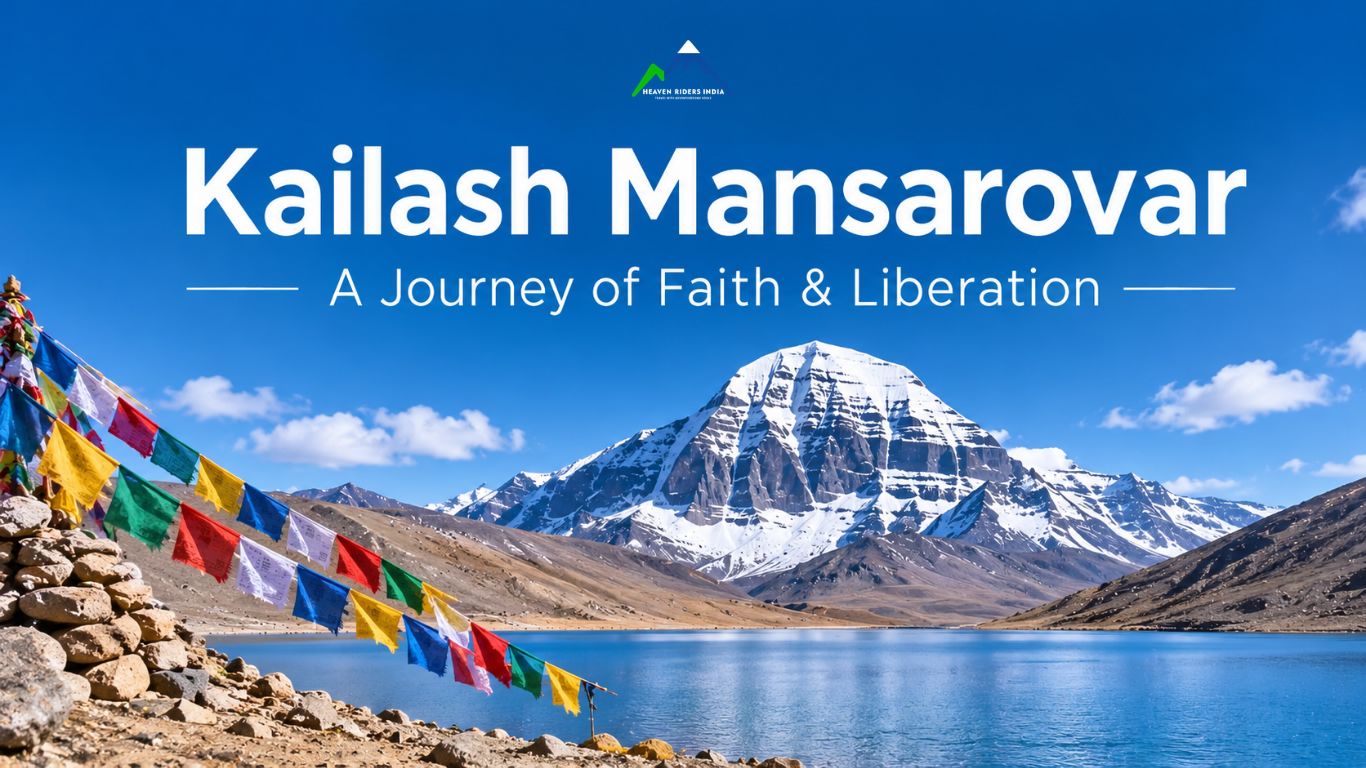
Planning the Kailash Mansarovar Yatra is a dream for many devotees. Located in the remote Tibetan region of the Himalayas, Mount Kailash holds a special place in Hinduism, Buddhism, Jainism, and Bon. Every year, pilgrims travel long distances to visit this sacred mountain and Lake Mansarovar, hoping to experience the spiritual peace and connection that this journey offers.
The journey is challenging, with high-altitude roads, long travel days, and the famous Kailash Parikrama. However, for many pilgrims, the experience of standing in front of Mount Kailash makes every part of the journey worthwhile.
At Heaven Riders India, we help travellers plan their Kailash Mansarovar Yatra with proper arrangements for transportation, accommodation, permits, and on-ground support. Whether you are travelling with family, friends, or joining a group, our team helps you understand the journey and prepare for it.
In this guide, we cover everything you should know before planning your Kailash Mansarovar Yatra, including routes, package costs, the best time to visit, medical requirements, permits, and the Kailash Parikrama.
Spiritual Significance of Mount Kailash and Lake Mansarovar
Mount Kailash stands at an altitude of approximately 6,638 metres and is considered one of the holiest mountains in the world. Unlike other famous Himalayan peaks, Mount Kailash has never been climbed. For devotees, its importance goes far beyond its height or location.
Different religions have their own beliefs and connections with this mountain.
Hinduism: Mount Kailash is believed to be the home of Lord Shiva and Goddess Parvati. Many devotees believe that completing the Kailash Parikrama helps cleanse past sins and brings them closer to spiritual liberation.
Buddhism: Known as Kangrinboqe in Tibetan, Mount Kailash is associated with Buddha Demchok (Chakrasamvara). It is also connected with the Buddhist understanding of Mount Meru, the centre of the universe.
Jainism: According to Jain beliefs, Rishabhadeva, the first Tirthankara, attained liberation at Mount Ashtapada, traditionally associated with the Kailash region.
Bon Religion: In the ancient Bon tradition of Tibet, Mount Kailash is regarded as a sacred centre of spiritual power.
A short distance from Mount Kailash lies Lake Mansarovar, situated at approximately 4,590 metres above sea level. Its clear waters and peaceful surroundings make it one of the most important stops during the pilgrimage.
Many pilgrims take a holy dip or perform prayers beside the lake. For devotees, visiting both Mount Kailash and Lake Mansarovar is an experience they have looked forward to for years.
Kailash Mansarovar Yatra Routes
There are three commonly discussed routes for the Kailash Mansarovar Yatra. Each route has a different travel experience, duration, and level of physical difficulty.
Your choice will depend on your budget, travel preferences, fitness, and the availability of permits.
1. Kailash Mansarovar Yatra via Kathmandu (Nepal Route)
The Kathmandu route is a popular option for Indian and international pilgrims. The journey begins in Kathmandu, Nepal, and continues towards the Tibet border before reaching Mount Kailash and Lake Mansarovar.
From Kathmandu, travellers usually proceed towards the Rasuwagadhi–Kerung border. After completing the necessary border formalities, the journey continues through places such as Saga and other settlements in Tibet.
Route Details:
- Total Duration: Approximately 14–18 days
- Starting Point: Kathmandu, Nepal
- Border Crossing: Rasuwagadhi–Kerung (Kyirong)
- Major Stops: Kathmandu, Kerung, Saga, Lake Mansarovar, Darchen, and Mount Kailash
- Best For: Pilgrims looking for a road-based journey with organised travel arrangements.
One advantage of this route is that pilgrims can reach the Tibetan region by road without undertaking the long trekking approach involved in some traditional routes.
The journey also gives travellers an opportunity to visit important religious places in Kathmandu, including Pashupatinath Temple and Boudhanath Stupa.
Heaven Riders India offers group and private Kailash Mansarovar Yatra packages through Kathmandu, subject to the required permits and travel arrangements.
2. Kailash Mansarovar Yatra via Lipulekh Pass (Uttarakhand Route)
The Lipulekh route is the traditional Indian route to Kailash Mansarovar. It is organised by the Ministry of External Affairs, Government of India, in coordination with Kumaon Mandal Vikas Nigam (KMVN).
The journey generally starts from Delhi and continues through different parts of Uttarakhand, including Dharchula and Gunji. Pilgrims then cross the high-altitude Lipulekh Pass to enter Tibet.
Route Details:
- Total Duration: Approximately 24–28 days
- Starting Point: Delhi
- Major Stops: Dharchula, Gunji, Lipulekh Pass, and the Kailash region
- Highest Pass: Lipulekh Pass, approximately 5,334 metres
- Best For: Pilgrims interested in following the traditional Indian government-organised route.
This route requires good physical preparation because of the trekking sections and high-altitude conditions. Pilgrims also need to complete the prescribed medical examinations and selection process.
3. Kailash Mansarovar Yatra via Nathu La Pass (Sikkim Route)
The Nathu La route offers another option for Indian pilgrims travelling to Kailash Mansarovar. It was introduced as an alternative to the Lipulekh route and allows travellers to cover a larger part of the journey by road.
The journey begins from Gangtok in Sikkim and continues towards the Nathu La border before entering Tibet.
Route Details:
- Total Duration: Approximately 21–24 days
- Starting Point: Gangtok, Sikkim
- Major Route: Gangtok, Nathu La, and the Tibetan region
- Best For: Pilgrims who prefer road travel and want to reduce the amount of trekking.
This route may be a more comfortable option for some travellers, particularly those who find long trekking sections difficult. However, high-altitude travel still requires medical fitness and proper acclimatisation.
Kailash Mansarovar Parikrama: The Sacred Kora Around Mount Kailash
The Kailash Parikrama, also known as the Kailash Kora, is considered the most important part of the pilgrimage for many devotees.
During the Parikrama, pilgrims walk around Mount Kailash along a circular route of approximately 52 km. The journey usually takes three days and passes through remote valleys, rocky paths, glaciers, and high-altitude mountain terrain.
One of the most challenging sections is the climb to Dolma La Pass, which stands at approximately 5,630 metres. The steep ascent, thin air, and changing weather make this stretch physically demanding.
Despite the difficulty, many pilgrims consider crossing Dolma La Pass a deeply meaningful moment of their journey.
According to religious beliefs, completing one Parikrama helps a person overcome the sins of their lifetime, while completing 108 Parikramas is traditionally associated with attaining moksha.
Pilgrims who find the trek difficult because of age or physical limitations may be able to arrange pony or yak support on permitted sections. Those who cannot undertake the full Parikrama can also explore darshan-only packages, depending on the available arrangements.
Difference Between Inner Kora and Outer Kora
There are two types of Parikrama associated with Mount Kailash: the Outer Kora and the Inner Kora. Both hold religious importance, but they offer very different experiences in terms of distance, difficulty, and accessibility.
The Outer Kora is the traditional route followed by most pilgrims, while the Inner Kora takes travellers closer to Mount Kailash and involves more challenging terrain.
Outer Kora (Outer Parikrama)
The Outer Kora is the main Parikrama route around Mount Kailash and is followed by most pilgrims during the Kailash Mansarovar Yatra.
The route covers approximately 52–54 km and usually takes two to three days to complete. Along the way, pilgrims pass through beautiful mountain valleys, sacred sites, and resting points. One of the most challenging sections is the climb to Dolma La Pass, which stands at approximately 5,630 metres.
Some important things to know about the Outer Kora:
- Covers approximately 52–54 km around Mount Kailash.
- Usually takes 2–3 days to complete.
- Crosses Dolma La Pass at around 5,630 metres.
- Includes established resting points, monasteries, and basic guesthouse facilities.
- The standard Parikrama followed by most Kailash Mansarovar pilgrims.
For many devotees, completing the Outer Kora is one of the most meaningful parts of the entire pilgrimage.
Inner Kora (Inner Parikrama / Nandi Parikrama)
The Inner Kora follows a more difficult route closer to Mount Kailash, including the sacred Nandi Parvat region. Unlike the Outer Kora, this route is less commonly attempted and requires greater physical preparation.
The terrain is more challenging, the altitude is higher, and facilities along the route are limited. Some sections reach the Saptarishi Cave region, making the journey physically demanding.
Here are a few things to know about the Inner Kora:
- Covers approximately 30–35 km, depending on the route.
- Generally takes 1–2 days.
- Reaches high-altitude areas, including the Saptarishi Cave region.
- Has very limited facilities along much of the route.
- May require additional permissions and is subject to local restrictions.
Traditionally, pilgrims complete the Outer Kora before attempting the Inner Kora. However, access to the Inner Kora has been restricted at different times and depends on the permissions granted by Chinese authorities. It is important to check the latest access conditions before making any plans.
Inner Kora vs Outer Kora: Key Differences
Feature | Outer Kora | Inner Kora |
Distance | Approximately 52–54 km | Approximately 30–35 km |
Duration | 2–3 days | 1–2 days |
Highest Point | Dolma La Pass, around 5,630 m | Saptarishi Cave area, around 5,860 m |
Difficulty | Strenuous | Extremely challenging |
Facilities | Basic guesthouses and resting points | Very limited facilities |
Permissions | Standard Yatra permits | Additional permissions may be required |
Who Attempts It | Most Parikrama pilgrims | Experienced and well-prepared pilgrims |
Main Attractions During the Kailash Mansarovar Yatra
The Kailash Mansarovar Yatra takes you through some of the most sacred places in the Himalayan and Tibetan regions. Along the way, you will come across ancient temples, holy lakes, mountain passes, and locations connected with different religious beliefs.
Each place has its own story, and many pilgrims look forward to visiting these locations as part of their spiritual journey.
Here are some of the important attractions associated with the Kailash Mansarovar Yatra.
1. Mount Kailash
Mount Kailash is the main destination of the entire pilgrimage. Standing at approximately 6,638 metres, this sacred mountain is known for its distinctive shape and snow-covered slopes.
For Hindus, Mount Kailash is believed to be the home of Lord Shiva and Goddess Parvati. It is equally sacred to followers of Buddhism, Jainism, and the Bon religion.
For many pilgrims, seeing Mount Kailash for the first time is an emotional experience. Its presence throughout the Parikrama makes the journey even more meaningful.
2. Lake Mansarovar
Lake Mansarovar is one of the most sacred lakes in the world and is located close to Mount Kailash.
The lake is known for its clear blue water and beautiful mountain surroundings. Pilgrims often spend time along its banks performing prayers and religious rituals. Some also take a holy dip as part of their spiritual beliefs.
The peaceful atmosphere around Lake Mansarovar makes it one of the most memorable stops during the yatra.
3. Gauri Kund
Gauri Kund is a small sacred lake located along the Kailash Parikrama route, near the descent from Dolma La Pass.
According to Hindu beliefs, the lake is associated with Goddess Parvati. It holds special importance for devotees who consider it a sacred part of the Kailash pilgrimage.
Reaching this area can be physically demanding because of the high altitude and steep terrain, but it remains an important spiritual location along the route.
4. Rakshas Tal
Rakshas Tal, also known as Rakshastal, is a saltwater lake situated close to Lake Mansarovar.
According to Hindu mythology, the lake is associated with Ravana, who is believed to have performed penance here to please Lord Shiva.
Unlike the calm and peaceful surroundings of Lake Mansarovar, Rakshas Tal has a different appearance and atmosphere. The contrast between these two nearby lakes makes the region particularly interesting for visitors.
5. Hanuman Tal
Hanuman Tal is a lesser-known water body associated with Lord Hanuman.
It is sometimes mentioned among the religious sites connected with the Kailash region. Depending on the route and travel arrangements, visitors may have an opportunity to explore this location.
Pilgrims interested in the religious stories and traditions of the region may find it an interesting place to learn about.
6. Yam Dwar
Yam Dwar is traditionally regarded as the starting point of the Kailash Parikrama.
Its name is commonly understood as the Gateway of Death. According to religious beliefs, passing through Yam Dwar represents leaving behind worldly attachments before beginning the sacred journey around Mount Kailash.
Many pilgrims stop here to offer prayers before starting their Parikrama. It is one of the important spiritual landmarks along the Outer Kora route.
7. Dolma La Pass
Dolma La Pass is the highest point of the Outer Kora, located at approximately 5,630 metres above sea level.
The climb to the pass is one of the toughest sections of the Kailash Parikrama. The steep trail, high altitude, and low oxygen levels make it physically challenging.
The pass is named after Dolma, the Tibetan name for Goddess Tara in Buddhism. It holds deep religious significance, and crossing it is considered a major milestone for pilgrims.
From here, the trail continues downhill towards the Zutulpuk side.
8. Ashtapad
Ashtapad holds special importance in Jain tradition. According to Jain beliefs, Rishabhanatha, the first Tirthankara, attained liberation at this sacred location.
The site is traditionally associated with the Mount Kailash region and is an important place for Jain devotees.
Its religious connection makes Ashtapad a significant part of the wider spiritual history of Kailash.
9. Nandi Parvat
Nandi Parvat is a mountain formation located near Mount Kailash and is associated with Nandi, the sacred bull and vehicle of Lord Shiva.
In Hindu tradition, Nandi represents devotion and loyalty to Lord Shiva. The mountain holds particular importance in the religious geography surrounding Kailash.
The region is also connected with the Inner Kora, which follows a more challenging route closer to the sacred mountain.
10. Saptarishi Caves
The Saptarishi Caves are associated with the seven great sages, known as the Saptarishis in Hindu tradition.
According to religious beliefs, these sages meditated in the region. The caves are also connected with the spiritual traditions of the Inner Kora.
Because of their high-altitude location and difficult access, visiting this area requires careful planning and permission.
11. Pashupatinath Temple
Located in Kathmandu, Nepal, Pashupatinath Temple is one of the most important Hindu temples dedicated to Lord Shiva.
Situated along the banks of the Bagmati River, the temple attracts devotees from Nepal, India, and other parts of the world.
Many Kailash Mansarovar pilgrims visit Pashupatinath before travelling towards Tibet. For Shiva devotees, offering prayers here is a meaningful way to begin their pilgrimage.
12. Jal Narayan (Budhanilkantha Temple)
Jal Narayan, also known as Budhanilkantha Temple, is a famous Hindu temple in Kathmandu.
The temple is known for its large stone statue of Lord Vishnu resting on the coils of Sheshnag in a water tank. The peaceful setting and unique sculpture make it an interesting place to visit.
Some Kathmandu-based Kailash Mansarovar itineraries include a visit to this temple before the journey towards Tibet.
13. Boudhanath Stupa
Boudhanath Stupa is one of the largest and most important Buddhist stupas in Nepal.
Located in Kathmandu, it is an important centre of Tibetan Buddhist culture and religious activities. Visitors can see prayer wheels, colourful prayer flags, and devotees walking around the stupa while chanting prayers.
For pilgrims travelling through Kathmandu, Boudhanath offers an opportunity to experience the region’s Buddhist traditions before continuing towards Mount Kailash.
14. Guhyeshwari Mata Temple
Guhyeshwari Mata Temple is an important Hindu temple in Kathmandu, dedicated to Goddess Guhyeshwari.
It is regarded as one of the Shakti Peethas and is located close to Pashupatinath Temple. The temple holds special importance for devotees of Goddess Shakti.
Many pilgrims include a visit to Guhyeshwari Temple as part of their Kathmandu sightseeing before beginning the Kailash Mansarovar Yatra.
Best Time to Visit Kailash Mansarovar
The Kailash Mansarovar Yatra generally takes place between May and September. During these months, weather conditions are comparatively suitable for travelling through the high-altitude Tibetan region.
However, conditions can change quickly, so the final travel schedule depends on weather, road conditions, and government permissions.
Here is what you can expect during different months.
May to June:
These months mark the beginning of the yatra season. The weather gradually becomes suitable for travel, and the surrounding mountains may still have snow. Temperatures can be quite low, especially during early mornings and nights.
July to August:
This is a popular period for the yatra. Many devotees plan their journey around important religious occasions, including Guru Purnima. Weather conditions in Tibet are generally suitable for travel, although rainfall on the Nepal side can sometimes affect road conditions.
September:
September is often preferred by travellers who want clearer mountain views. The monsoon gradually withdraws from the region, and the landscape can look particularly beautiful.
The best month for your journey depends on your preferred dates, weather conditions, and permit availability.
Heaven Riders India offers fixed group departures and private travel arrangements during the yatra season, subject to operational schedules and approvals.
Eligibility and Medical Requirements for Kailash Mansarovar Yatra
The Kailash Mansarovar Yatra involves travelling through areas above 4,000 metres, with the Parikrama reaching more than 5,600 metres. Because of these conditions, physical fitness is an important part of the preparation.
Before booking, travellers should understand the eligibility requirements for their selected route.
Age: Age restrictions may differ between government-organised and private tours. Travellers should confirm the current eligibility criteria before registration.
Medical Fitness: A medical check-up is strongly recommended. People with heart conditions, uncontrolled blood pressure, respiratory problems, or other serious medical conditions should consult a doctor before considering the journey.
Physical Preparation: Regular walking, light hiking, and cardiovascular exercise can help prepare your body for long travel days and the Parikrama.
Government Route Requirements: Pilgrims applying through the Indian government route must complete the prescribed medical screening and other formalities.
Do not rely only on age or general fitness when deciding whether to travel. A doctor’s assessment is important, especially for senior citizens and people with existing medical conditions.
Why Travel with Heaven Riders India?
Planning a journey like Kailash Mansarovar involves much more than booking hotels and transportation. You need to understand the route, arrange permits, prepare for high altitude, and have reliable support during the trip.
At Heaven Riders India, we help pilgrims manage these arrangements so they can focus on their journey.
Here is what you can expect when travelling with us:
Experienced Travel Team: Our team has experience organising Himalayan journeys and understands the planning required for high-altitude travel.
Small Group Departures: We keep our group sizes limited to provide better coordination and personal attention during the journey.
Permit Assistance: Our team coordinates the required travel documentation through authorised Tibetan and Nepali partners.
Clear Package Details: We explain the package inclusions, exclusions, and additional expenses before booking.
Medical and Safety Support: We plan for basic medical assistance, oxygen support, and acclimatisation according to the itinerary.
24/7 Travel Assistance: Our team remains available to help with travel-related concerns and coordination throughout the trip.
Group and Private Packages: Depending on your requirements, you can enquire about group departures or customised travel arrangements.
Our aim is to make the planning process easier and help you prepare for the journey with a clear understanding of what to expect.
Contact us at +91 73800 87934 for more details about Kailash Mansarovar Packages.
Frequently Asked Questions About Kailash Mansarovar Yatra
1. How can I apply for the Kailash Mansarovar Yatra?
Indian pilgrims interested in the government-organised route can register through the Ministry of External Affairs website at kmy.gov.in, subject to the availability of applications and current guidelines.
For private tours through Kathmandu, you can contact an authorised tour operator such as Heaven Riders India to understand the booking process, documents, and permit requirements.
2. What is the total Kailash Mansarovar Yatra cost, including flights?
The total cost depends on your selected package and travel arrangements.
Based on the indicative package prices mentioned above, a Kathmandu-based trip may cost approximately ₹1,70,000–₹3,20,000 per person, including return flights from major Indian cities.
Actual prices depend on flight fares, package inclusions, and the travel season.
3. Is the Kailash Mansarovar Yatra safe?
The journey can be completed safely with proper planning, medical preparation, and experienced on-ground support. However, it involves high-altitude travel and challenging weather conditions.
Travellers should choose a reliable operator, complete their medical check-ups, follow acclimatisation guidelines, and take altitude sickness symptoms seriously.
4. Can senior citizens undertake the Kailash Mansarovar Yatra?
Yes, some senior citizens successfully complete the journey, provided they meet the medical and physical fitness requirements.
However, age alone does not determine whether someone is fit for the yatra. A medical assessment is important before booking.
The amount of walking required during the Parikrama should also be considered. Ponies may be available for assistance, but their availability and suitability cannot be guaranteed.
5. Which currency should I carry during the Kailash Mansarovar Yatra?
The official currency in Tibet is the Chinese Yuan (CNY or RMB).
It is advisable to carry sufficient local currency for personal expenses, as ATM and card facilities are limited in remote areas. You can arrange currency exchange before entering Tibet.
6. Is travel insurance required for Kailash Mansarovar Yatra?
Travel insurance covering high-altitude travel and emergency medical evacuation is strongly recommended.
Before purchasing a policy, check whether it covers trekking at elevations above 5,000 metres, medical emergencies, and evacuation. Standard travel insurance may not cover these activities.
7. How difficult is the Kailash Parikrama?
The Kailash Parikrama is physically demanding because of its high altitude, long walking distances, and steep sections.
The second day, which includes crossing Drolma La Pass at approximately 5,636 metres, is generally the most challenging.
Regular walking and physical preparation can help, but travellers should also be medically fit for high-altitude conditions.
8. Can I visit Lake Mansarovar without completing the Kailash Parikrama?
The travel arrangements and permissions depend on the selected package and current regulations. Some itineraries may allow travellers to visit Lake Mansarovar without completing the full Parikrama.
Pilgrims who are unable to undertake the trek should discuss suitable options with their tour operator before booking.
9. What is the best month for the Kailash Mansarovar Yatra?
May to September is generally considered the main travel season.
June and September are popular choices among travellers, but actual conditions depend on weather and road accessibility. Always check the latest departure information before finalising your dates.
Plan Your Kailash Mansarovar Yatra with Heaven Riders India
The Kailash Mansarovar Yatra is a journey many devotees dream of completing at least once in their lifetime. From the first glimpse of Mount Kailash to the peaceful surroundings of Lake Mansarovar and the experience of completing the Parikrama, every stage has its own meaning.
The journey also requires careful preparation. High altitude, changing weather, travel permits, and long road journeys make it important to plan everything in advance.
At Heaven Riders India, we help you understand the route, choose a suitable package, and prepare for the journey with the necessary travel arrangements and support.
Whether you are looking for a Kailash Mansarovar Yatra package from Kathmandu, want to know the latest Kailash Mansarovar Yatra cost, or need help planning a private trip, our team is here to assist.
Contact Heaven Riders India to discuss your travel dates, package options, and preparation for the Kailash Mansarovar Yatra.