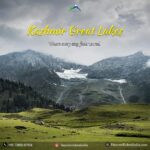
Every winter, the Spiti Valley trades its rugged brown landscape for a blanket of white silence. Rivers freeze mid-flow, monasteries stand wrapped in snow, and villages perched above 13,000 feet carry on with quiet resilience against temperatures that can drop below -20°C. For travelers who crave real adventure not the postcard kind, but the kind that tests your grit and rewards you with landscapes almost nobody else gets to see a Spiti winter expedition 4×4 is one of the most rewarding road trips in India.
At Heaven Riders India, we’ve spent seasons refining our winter itinerary around three non-negotiables: safety, authenticity, and genuine adventure. If you’ve been searching for a Spiti valley winter tour that goes beyond the ordinary Instagram checklist, this guide covers everything — the route, the villages, the weather, the permits, the packing list, and exactly what to expect when you sign up for one of our 4×4 Vehicle convoys into the Trans-Himalaya.
Why Choose a Spiti Winter Expedition 4×4?
Spiti in winter isn’t for the faint-hearted, and that’s exactly its appeal. Between November and March, the valley is cut off from the Manali side entirely, since the Kunzum Pass and Rohtang Pass remain buried under heavy snow. The only way in and out during this season is via the Shimla–Kinnaur–Kaza route, along the historic Hindustan-Tibet Highway (NH-5) — a road that stays functional almost year-round because, unlike the Manali route, it doesn’t cross any high mountain pass.
This single fact is what makes a 4×4 winter Spiti tour essential rather than optional. Icy patches, sudden snowfall, single-lane traffic through the Kinnaur belt, and narrow mountain roads all demand a vehicle built for grip, ground clearance, and control. A regular sedan simply isn’t built for these conditions once the snow sets in. Heaven Riders India uses well-maintained 4×4 SUVs for every winter departure, each driven by a local driver-cum-guide who has spent years navigating this exact stretch of highway in every season and every kind of weather.
Beyond the practical necessity, there’s something deeply satisfying about a 4×4 expedition through snow. The steady crunch of tires on a fresh layer of powder, the moments where the road disappears into white and your driver reads the terrain by instinct — this is adventure travel in its purest form, and it’s precisely what draws repeat travelers back to Spiti year after year.
The Route: Chandigarh to Kaza via Kinnaur
Our Spiti winter expedition 4×4 follows the classic and safest entry point into the valley:
Chandigarh → Narkanda → Rampur → Kalpa → Nako → Tabo → Kaza
This route covers approximately 412–420 km one way and offers a gradual altitude gain, which helps your body acclimatize naturally as you climb from Shimla (around 2,200 m) to Kalpa (around 2,960 m), Nako (around 3,660 m), and finally to Kaza (around 3,650 m). Unlike the Manali side, where travelers gain over 8,000 feet of altitude within a single day crossing Kunzum Pass, the Kinnaur route lets you rise slowly through a series of charming towns — significantly reducing the risk of acute mountain sickness (AMS), which is one of the biggest concerns for first-time high-altitude travelers.
A Sample 7-Day Itinerary
While exact day plans can shift depending on snow conditions, here’s a representative structure of how a Heaven Riders India winter expedition typically unfolds:
- Day 1: Chandigarh to Kalpa/Sangla – Depart Chandigarh, pass through Narkanda and Rampur-Bushahr, and enter the dramatic Kinnaur Valley. Overnight in Kalpa or the Sangla Valley, with your first views of the Kinner Kailash range.
- Day 2: Kalpa to Nako/Tabo – A long, scenic drive along the Hindustan-Tibet Highway, passing through Pooh and Nako before descending into the high-altitude desert of Spiti. Overnight homestay in Tabo.
- Day 3: Tabo to Kaza – Explore Tabo Monastery in the morning, then continue toward Dhankar and on to Kaza, your base for the next few days.
- Day 4: Kaza local sightseeing – Visit Key Monastery, Kibber, and Chicham Bridge. Spend the day exploring snow-covered village lanes and frozen viewpoints.
- Day 5: Langza, Hikkim, Komic – A full day dedicated to Asia’s highest villages, including a stop at the world’s highest post office in Hikkim.
- Day 6: Kaza to Kalpa/Rampur – Begin the return journey south, retracing the Kinnaur route with fresh perspectives on the landscape you passed earlier.
- Day 7: Return to Chandigarh – Drive back to Chandigarh, arriving by evening with memories (and photographs) that will last a lifetime.
Top Places to Visit in Spiti during winter
Kaza
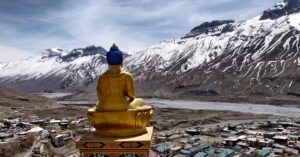
Kaza is where the expedition slows down. As Spiti’s largest town and our base for several days, it has just enough infrastructure — a market, a few cafés, patchy mobile network — to feel like civilization after the long drive in, while still sitting at nearly 12,000 feet, ringed by bare, snow-dusted peaks. It’s also your launch point for day trips to Key, Kibber, Langza, and Hikkim.
Key Monastery
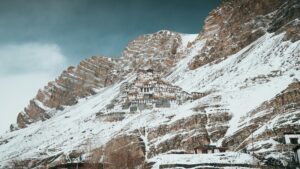
Key Monastery is the postcard shot of Spiti — a cluster of whitewashed buildings stacked up a conical hill, visible from miles down the valley. In winter it’s usually half-buried in snow, and with far fewer visitors around than in the summer months, you can actually sit in on a prayer session or wander its stairwells and rooftop terraces in near silence.
Dhankar Monastery
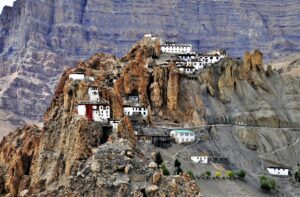
Dhankar clings to a narrow ridge above the point where the Pin and Spiti rivers meet, its mud-brick walls almost indistinguishable from the cliff face beneath them. It once served as the seat of the old Spiti kingdom, and the short climb to the newer temple above gives one of the widest valley views on the entire route.
Langza village
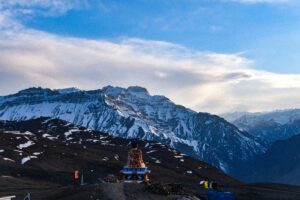
A giant golden Buddha statue watches over Langza’s scatter of mud-brick homes, with the Chau Chau Kang Nilda peak rising behind it. The surrounding hillsides are known for marine fossils a reminder that this high-altitude desert was once seabed and in winter the whole village goes still and white.
Geu Monastery
Geu is a short detour off the main route, known for one striking thing: the naturally mummified remains of a monk, believed to be over 500 years old and preserved without any embalming. It’s a quiet, slightly eerie stop that most first-time visitors to Spiti never even hear about.
Chitkul village
Chitkul marks the last inhabited village before the Indo-Tibet border, and its wooden houses and prayer flags set against a wall of snow peaks make it one of the most photographed stops on the route. Look out for the small roadside eatery signed “Hindustan ka Akhri Dhaba” — the last dhaba of India — for hot tea and Maggi before the road effectively ends.
Chicham Bridge
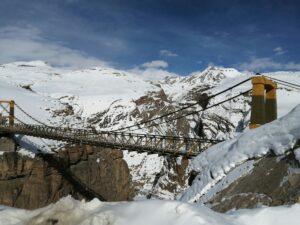
At over 13,000 feet, Chicham Bridge spans a deep gorge between Kibber and Chicham villages and is reportedly one of Asia’s highest suspension bridges. Standing on it with the canyon dropping away on both sides is one of those moments no photo quite captures.
Khab
At Khab, the Spiti River finally empties into the much larger Satluj, and the colour contrast between the two — one glacial blue, one murkier — is visible right from the bridge. It’s a brief stop on the drive in, but a good reminder of how far the Spiti River has travelled to get here.
Tabo Monastery
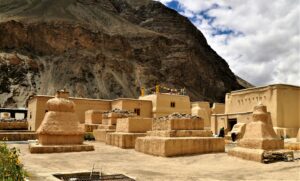
Founded in 996 AD, Tabo Monastery is among the oldest continually operating Buddhist monasteries in India, sometimes called the “Ajanta of the Himalayas” for the centuries-old wall paintings and stucco figures inside its mud-walled halls. It’s also where most Heaven Riders India winter groups spend their first night in Spiti proper.
At Heaven Riders India, our 4×4 vehicles are equipped to handle the village roads around Kaza, giving you access to these remote settlements even when snow makes conditions genuinely difficult for regular sedans and lower-clearance vehicles.
What to Expect: Weather and Temperatures
Winter in Spiti is harsh, and preparation matters more than anything else on this trip. Based on real on-ground conditions:
- Daytime temperatures typically range between -5°C and 5°C, sometimes touching slightly higher on clear, sunny days.
- Night temperatures can plummet to -15°C, and in the deepest winter months of December and January, parts of the valley have recorded lows close to -30°C.
- Snowfall is common between November and March, with the valley remaining under a thick white cover through much of the season.
- The road between Kaza and Tabo can occasionally close for a day or two during heavy snowfall, so our itineraries always build in buffer days to absorb these delays without disrupting your overall trip.
- Water pipes in homestays can freeze overnight, and electricity supply can be intermittent in remote villages — part of the raw, authentic experience of winter travel in this region.
Packing warm layers, thermal wear, sturdy waterproof snow boots, and a good sleeping bag rated for sub-zero temperatures is non-negotiable for this trip. Our team sends every traveler a detailed packing checklist well before departure, and our guides carry additional emergency supplies in every vehicle.
Recommended Packing List
- Thermal inners (upper and lower), fleece layers, and a heavy down jacket
- Waterproof and windproof outer shell jacket
- Woolen cap, neck gaiter or balaclava, and insulated gloves
- Trekking or snow boots with good grip, plus woolen socks
- UV-protection sunglasses (snow glare is intense at altitude)
- Sunscreen and lip balm for high-altitude sun exposure
- A basic personal medical kit, including Diamox (only on doctor’s advice) for altitude acclimatization
- Power banks and extra batteries, as charging points can be limited in remote homestays
- A refillable water bottle and some dry snacks for long driving stretches
Acclimatization and Altitude Health Tips
Since much of the Spiti Valley sits above 11,000 feet, and some villages like Komic and Kibber go even higher, altitude sickness is a genuine consideration. Here’s how we help manage it on every Heaven Riders India expedition:
- Gradual ascent: Our route via Kinnaur is specifically chosen to allow your body to adjust slowly, rather than gaining thousands of feet in a single day.
- Built-in rest days: Overnight halts in Kalpa and Tabo before reaching Kaza give your body time to adapt.
- Hydration: Cold, dry mountain air dehydrates the body faster than most travelers expect — we encourage frequent water breaks throughout each day’s drive.
- Awareness of symptoms: Our guides are trained to recognize early signs of AMS, such as persistent headaches, nausea, or dizziness, and know when to pause the itinerary for extra rest.
- Avoiding alcohol and heavy exertion in the first 24-48 hours at higher altitudes significantly reduces AMS risk.
Accommodation and Food on the Winter Route
One of the most memorable parts of any Spiti valley winter tour is the accommodation itself. In villages like Tabo and Kaza, we stay in traditional homestays run by local Spitian families, offering a level of warmth and hospitality that no hotel can replicate. Rooms are simple but comfortable, typically heated with a bukhari (traditional wood or coal stove), and meals are home-cooked using local ingredients — think hearty dal, rice, seasonal vegetables, and warming soups perfectly suited for the cold.
In Kalpa and Rampur, where infrastructure is slightly more developed, we use comfortable guesthouses and hotels. Throughout the trip, our focus stays on authentic, community-based tourism — supporting local families directly rather than large hotel chains, which also means your travel spend contributes meaningfully to the local Spitian economy.
Why Travel with Heaven Riders India
We designed our Spiti winter expedition 4×4 package around three core principles: safety, authenticity, and comfort.
- Rugged 4×4 Vehicles driven by experienced, English-speaking local drivers who know every bend of the Hindustan-Tibet Highway, in every season and weather condition.
- Homestay accommodations in Tabo and Kaza, giving you a genuine taste of Spitian hospitality and warm, home-cooked meals.
- Small group sizes, typically 3-4 travelers per vehicle, for a personalized, safe, and immersive experience rather than a crowded bus-tour feel.
- Complete permit assistance, so there’s zero paperwork stress on your side before or during the trip.
- Trained guides with first-aid knowledge and altitude sickness awareness, prioritizing your safety at every stage of the journey.
Whether you’re an adventure photographer chasing frozen waterfalls, a road-trip enthusiast who wants to test a 4×4 on real snow, or simply someone looking to disconnect in one of the world’s most remote winter landscapes, this expedition delivers a rare kind of stillness mixed with genuine adrenaline.
Photography Opportunities on the Winter Route
For photographers, a Spiti winter expedition 4×4 offers a completely different visual language compared to the summer months. Some of the standout moments our travellers capture include:
- The frozen Spiti River winding like a sparkling blue-white ribbon through the valley
- Snow-draped monasteries at Key, Tabo, and Dhankar set against deep blue winter skies
- Traditional Spitian homes with icicles hanging from wooden eaves
- Star-filled night skies over Kaza, with minimal light pollution and crisp, dry winter air
- Wildlife tracking moments around Kibber and Chicham, in hopes of a snow leopard sighting
Golden hour light in winter tends to be softer and lasts longer near sunrise and sunset, making early mornings and late afternoons the best windows for capturing the valley at its most dramatic.
Responsible Travel in Spiti
Spiti’s ecosystem and communities are fragile, and winter tourism, while growing, still needs to be handled with care. At Heaven Riders India, we follow a few core principles on every expedition:
- Carrying back all non-biodegradable waste rather than leaving it in villages with limited waste management infrastructure
- Respecting monastery photography rules and local customs, especially inside active prayer halls
- Supporting homestays and local guides directly, keeping tourism revenue within the community
- Avoiding unnecessary noise or disturbance near wildlife zones, particularly around known snow leopard habitats
Traveling responsibly ensures that Spiti’s villages and landscapes remain as breathtaking for the next generation of travelers as they are today.
Best Time for a Spiti Winter Expedition
The winter season in Spiti generally runs from the first week of November to the last week of March, with peak snow experiences typically in December, January, and February. If you want maximum snowfall and that true “frozen valley” look — deep snow, fully frozen rivers, and empty white landscapes — plan your 4×4 Spiti winter tour for mid-December through February. Late November and early March offer a slightly milder version of winter, with less extreme cold but still plenty of snow cover in the higher villages.
Frequently Asked Questions about Spiti Winter
Is Spiti Valley accessible in winter?
Yes. While the Manali–Kaza route via Kunzum Pass shuts down completely from around late October until May, the Shimla–Kinnaur–Kaza route remains operational through most of the winter, making winter travel to Spiti possible via 4×4 vehicles.
Do I need prior driving experience for a Spiti winter 4×4 trip?
No. With Heaven Riders India, professional local drivers handle every stretch of the snow-covered highway, so you can simply sit back and take in the views. If you’re an experienced driver yourself and want more hands-on involvement, ask us about our supervised self-drive options.
Can I spot snow leopards during the trip?
Winter significantly improves your chances, especially around Kibber and Chicham, where snow leopards descend to lower altitudes in search of prey. Sightings aren’t guaranteed, but this is one of the best seasons in India for a possible encounter.
How cold does it actually get in Spiti during winter?
Daytime temperatures generally range between -5°C and 5°C, while nights can drop to -15°C or lower, occasionally reaching close to -30°C during the coldest stretches of December and January.
Will I get altitude sickness on this trip?
The Shimla-Kinnaur route is specifically chosen because it allows gradual acclimatization, significantly lowering the risk compared to routes with sudden altitude gain. That said, individual susceptibility varies, so it’s important to follow our guides’ advice on hydration, rest, and pacing.
What kind of vehicle is used for the expedition?
Heaven Riders India uses well-maintained 4×4 Vehicle suited for snow and icy mountain roads, typically carrying 3-4 travelers per vehicle along with an experienced driver-cum-guide.
Are permits included in the package?
Yes, our team manages the Inner Line Permit process and any additional documentation required for foreign nationals, so you don’t need to handle this separately.
Ready to Book Your Spiti Winter Expedition 4×4?
Spiti in winter is a landscape few ever witness — silent, snow-draped, and completely untouched by the summer crowds. With Heaven Riders India, you get a professionally guided 4×4 winter Spiti tour built on years of experience navigating the Hindustan-Tibet Highway in the harshest, most beautiful months of the year.
Get in touch with Heaven Riders India today to check upcoming departure dates and reserve your seat in our next Spiti winter 4×4 convoy. This is one Himalayan adventure you’ll be recounting for years to come.